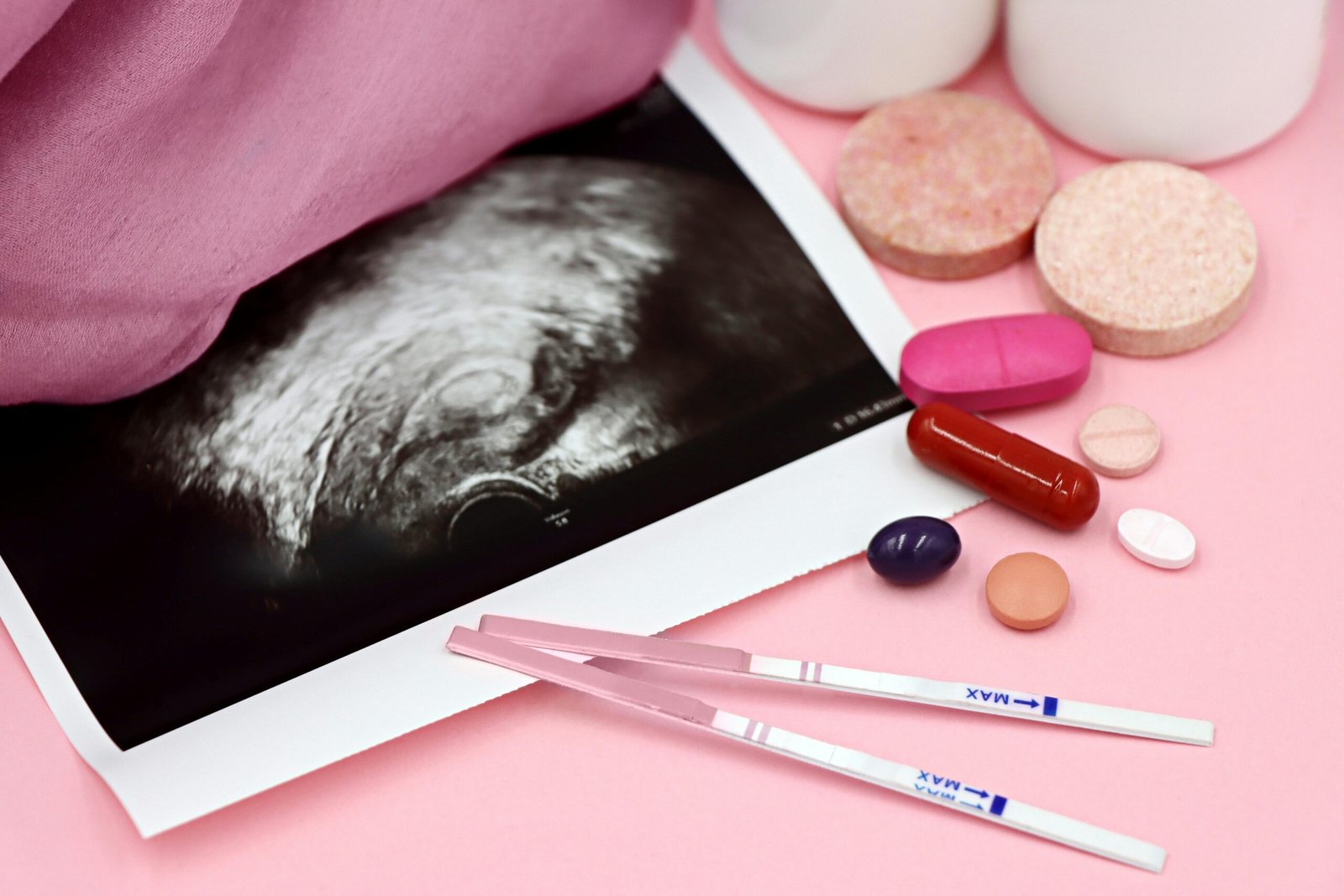
If you have just booked your first appointment at a Dutch reproduction clinic or you are already cycling through IVF, IUI or donor insemination — there is one question almost no one in the regular system has time to answer: what can you do for yourself, right now, to give this cycle the best possible chance? At Mesology Amsterdam this is exactly where we work. Not instead of your fertility clinic. Alongside it. Quietly, intelligently, and grounded in the most recent peer-reviewed science.
What recent research actually shows
The last two years have produced striking data on how the body’s terrain shapes the outcome of assisted reproductive technology (ART). A 2025 randomised clinical trial found that adding a mindfulness-based stress reduction programme and lifestyle coaching to standard IVF care raised the clinical pregnancy rate to 39.3%, compared with 22% in the control group (Hashemi-Bakhtiari et al., 2025). A large lifestyle review confirmed that couples following a Mediterranean-style diet were roughly 40% more likely to conceive after IVF or ICSI, with higher folate and vitamin B6 in blood and follicular fluid (Cunningham et al., 2025).
On the male side, a comprehensive Frontiers in Endocrinology review (2024) and Cochrane data showed antioxidant supplementation in subfertile men raised the clinical pregnancy odds nearly threefold (OR 2.97). On the female side, a 2025 review in endometrial receptivity revealed that women with a non-Lactobacillus-dominant uterine microbiome had an 18% lower pregnancy rate and a 50% higher risk of early miscarriage. Stress, inflammation, micronutrient status, the microbiome, hormonal balance, none of these are ‘soft’ factors. They are measurable, modifiable, and they show up in the live-birth statistics.
Why Mesology fits perfectly around an IVF, IUI or donor insemination trajectory
A fertility clinic does what it does brilliantly: stimulation, monitoring, retrieval, transfer. What it usually cannot offer, because of caseload and protocols, is a deep look at your individual terrain. That is the mesological niche. In a 90-minute intake we combine your medical history, cycle and semen analysis data with two diagnostic tools rarely available elsewhere:
Electro-Physiological Diagnostics (EFD/EPD), in which we measure the functional state of your endocrine and reproductive meridians using specific test ampoules, adrenal cortex, adrenal medulla, ovaries or testes, adrenaline and noradrenaline, to see exactly where your system is flipping under load.
Traditional Chinese Medicine pulse and tongue diagnosis, which adds an integrated picture of Kidney Jing, Liver Qi and the Ren / Chong / Du Mai, the three classical meridians that govern conception.
What I actually do for couples in a IVF clinic trajectory
Depending on your phase, I, Adriana Guarin, tailor the work:
- Before the cycle (90+ days): targeted preparation of egg and sperm quality through an anti-inflammatory food pattern, omega-3, CoQ10, zinc, selenium, folate (5-MTHF), vitamin D, plus identification and reduction of endocrine-disrupting exposures
- During stimulation: down-regulation of stress hormones, gentle support of liver detoxification, sleep and circadian rhythm so your body responds well to the protocol
- Around transfer: optimising endometrial receptivity through microbiome support, anti-inflammatory nutrition and calming the nervous system (mindfulness, breath, body work)
- After the cycle: emotional integration, hormonal reset and preparation for the next attempt if needed
- For couples using donor insemination, the focus shifts to the receiving partner’s terrain: cycle regularity, endometrial quality, microbiome and stress physiology — exactly the variables most strongly linked to live-birth rates in the recent literature.
Book your first IVF Support appointment
Do you recognise yourself in unexplained subfertility and want to understand what might be happening beneath the surface?
Book an integrative fertility consultation at Mesology Amsterdam for a whole‑person assessment of your male fertility.
What you can expect from a first intake
Ninety minutes, in my clinic in Amsterdam. I will map your story, look at all of your previous labs, semen analyses and cycle data, perform an EFD/EPD measurement, tongue and pulse diagnosis, and leave you with a clear, written plan.
No vague promises. Just the most intelligent use of the 3-month window your body gives you between today and your next cycle.
Frequently ~
Asked Questions
Questions ~
Yes, Mesology is complementary. It will keep all your prescribed medication and protocols intact, and I am happy to coordinate with your gynaecologist whenever useful.
Ideally 90 days before retrieval or insemination. That is one full cycle of spermatogenesis and roughly three menstrual cycles, the window where lifestyle and orthomolecular work has measurable biological impact. That said, even 4–6 weeks of preparation is meaningfully better than none.
Many Dutch supplementary health insurances reimburse part of the Mesology consultations. Check the policy of your insurance or check “Zorgwijzer“. I am also happy to answer questions or doubts.
Absolutely. The terrain work is the same and just as important.
Refferences
- Agarwal, A., Aponte-Mellado, A., Premkumar, B. J., Shaman, A., & Gupta, S. (2012). The effects of oxidative stress on female reproduction: A review. Reproductive Biology and Endocrinology, 10, 49.
- Barratt, C. L. R., Björndahl, L., De Jonge, C. J., et al. (2017). The diagnosis of male infertility: an analysis of the evidence to support the development of global WHO guidance. Human Reproduction Update, 23(6), 660–680.
- Cunningham, A. C., Prentice, R. N., & Hyett, J. A. (2025). The role of lifestyle intervention in female fertility: a modifiable target. Nutrients, 17(12), 2031. PMC12251342.
- Diamanti-Kandarakis, E., Bourguignon, J. P., Giudice, L. C., et al. (2009). Endocrine-disrupting chemicals: an Endocrine Society scientific statement. Endocrine Reviews, 30(4), 293–342.
- Gaskins, A. J., & Chavarro, J. E. (2018). Diet and fertility: a review. American Journal of Obstetrics and Gynecology, 218(4), 379–389.
- Hashemi-Bakhtiari, N., et al. (2025). The effects of lifestyle improvements and mindfulness-based stress reduction on pregnancy rate and anxiety in infertile women undergoing IVF: a randomized clinical trial. PMC12662573.
- Joseph, D. N., & Whirledge, S. (2017). Stress and the HPA axis: balancing homeostasis and fertility. International Journal of Molecular Sciences, 18(10), 2224.
- Karayiannis, D., Kontogianni, M. D., Mendorou, C., et al. (2018). Adherence to the Mediterranean diet and IVF success rate among non-obese women attempting fertility. Human Reproduction, 33(3), 494–502.
- Komiya, S., Naito, Y., et al. (2024). Lifestyle and fertility-specific quality of life affect reproductive outcomes in couples undergoing in vitro fertilization. Frontiers in Endocrinology, 15, 1346084.
- Maciocia, G. (2015). The Foundations of Chinese Medicine: A Comprehensive Text (3rd ed.). Elsevier.
- Osadchiy, V., Mills, J. N., & Eleswarapu, S. V. (2024). The seminal microbiome and male fertility. Fertility and Sterility, 121(4), 555–562. PMC review references.
- Osadchiy, V., Martin, C. R., & Mayer, E. A. (2017). The gut–brain axis and the microbiome: mechanisms and clinical implications. Clinical Gastroenterology and Hepatology, 17(2), 322–332.
- Salas-Huetos, A., et al. (2024). Antioxidant therapy for infertile couples: a comprehensive review of the literature. Frontiers in Endocrinology, 15, 1503905.
- Showell, M. G., Mackenzie-Proctor, R., Brown, J., et al. (2020). Antioxidants for male subfertility. Cochrane Database of Systematic Reviews, (3), CD007411.
- Sirota, I., Zarek, S. M., & Segars, J. H. (2025). From gut to gamete: how the microbiome influences fertility and assisted reproduction. PMC12465865.
- Tilbrook, A. J., Turner, A. I., & Clarke, I. J. (2000). Effects of stress on reproduction in non-rodent mammals: the role of glucocorticoids and sex differences. Reviews of Reproduction, 5(2), 105–113.
- Voronova, V., et al. (2025). Endometrial microbiome and reproductive receptivity. PMC12609489.
- Yilmaz, B., Terekeci, H., Sandal, S., & Kelestimur, F. (2020). Endocrine disrupting chemicals: exposure, effects on human health, mechanism of action, models for testing and strategies for prevention. Reviews in Endocrine and Metabolic Disorders, 21(1), 127–147.